
Anyone who's had to self-navigate a legal system such as VCAT or AFCA knows that the biggest challenge isn't what the ruling will be, but simply getting to a ruling. Navigating a complicated legal system, working out which forms and documents you need and in what format, and then trying to find your way through the tribunal's digital channels and portals, is all too overwhelming for many. My recent experiences self-representing across various matters after my home was flooded would have been near impossible if not for the help of AI. And it's got me wondering: if AI has been able to help me manage, analyse and draft documents as an applicant, how could it help the governing body?
As a service designer, the question sat with me. How could I have been aided by AI as an applicant — and how could a member or case manager have been helped by having AI as an available tool? After all, we're all users of the same system. I started to think about the different journeys through it: looking to apply, or submitting statements. I thought about how AI could support file management, search and document analysis. Could this improve the current system, and support broader connectivity across the various bodies a matter travels through?
Measuring that gap — between what a service does and how it feels to use — is the work I do every day, and have done effectively for many years in the private sector. Government and the justice system are hugely complex, and that complexity is exactly where service design earns its place: identifying where a technology like AI can be safely integrated into existing journeys, and where it can simplify them for everyone — both back-end and front.
Let me be clear: when I say 'simplify,' I'm certainly not advocating for the creation of a “robot judge.” There will always be a need for human oversight, and the function of the governing member remains. What could change is how all parties get to the end judgement — and how AI could help guide that ruling, which is ultimately and always made by a human.
The problem, seen as a designer sees it
Take a common matter: an owners-corporation dispute in Victoria, heard at VCAT — a jurisdiction that, since a 2025 ruling, now handles all such fee-recovery matters exclusively[15]. Today it follows a path that looks something like the diagram below.
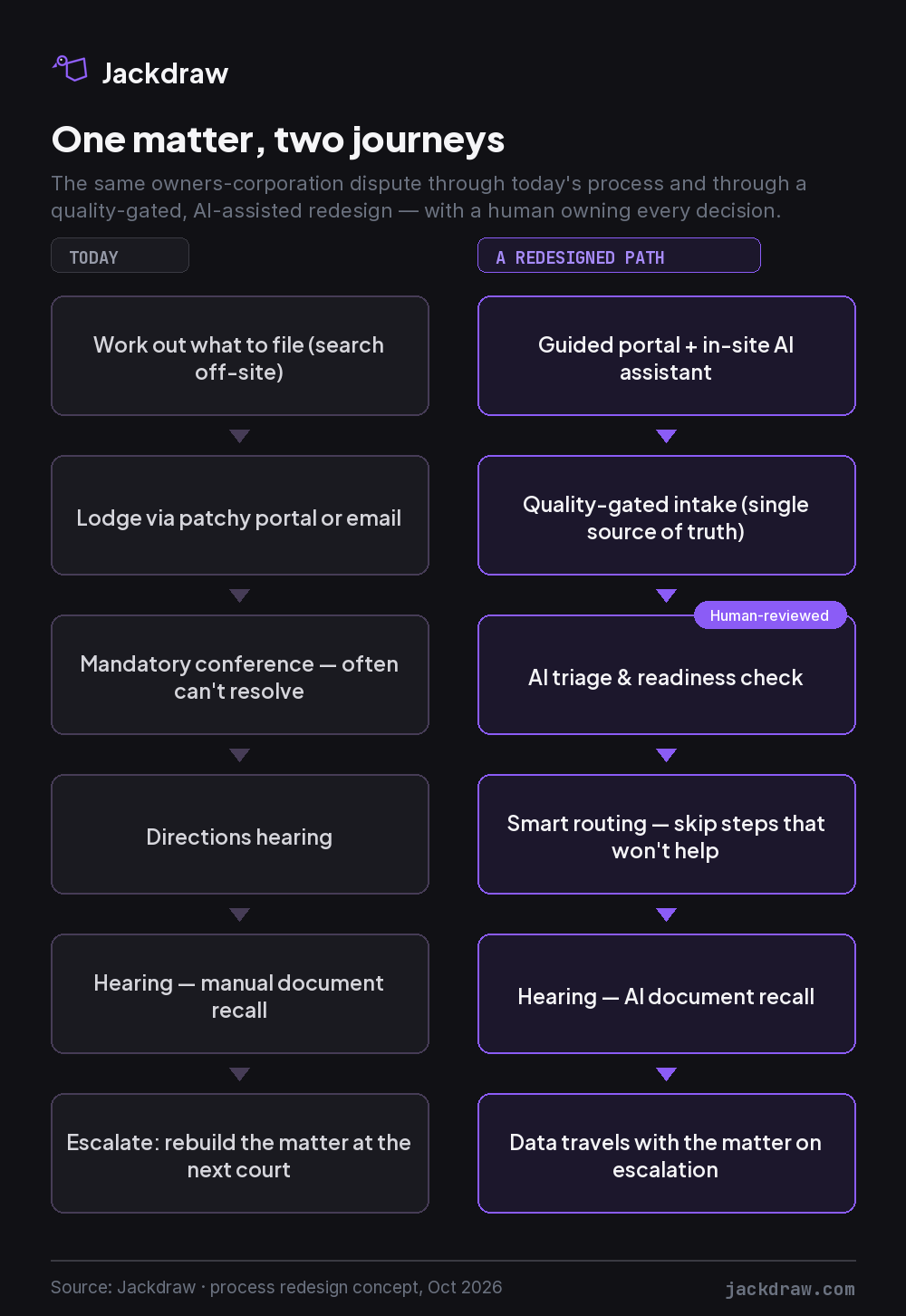
Three failures stand out, and none of them are about the law.
- 01
There's no guidance at the point of need
When you begin, the system's effective answer to “what kind of document do I even need here?” is: go and search for it. A public justice system is quietly outsourcing its own explainability to Google — which, for a nervous self-represented person, means generic, un-cited, possibly wrong-jurisdiction answers wrapped in law-firm ads, at exactly the moment they need accurate, specific, private help.
- 02
Some steps can't do the job they're there to do
A compulsory conference is valuable when a matter can settle. When it structurally cannot — as many owners-corporation matters cannot — it becomes a delay with a date on it, consuming the time of applicants and tribunal members alike.
- 03
Nothing carries across tiers
This is the costliest flaw, and the least discussed. When a matter escalates — VCAT to the Supreme Court, or the Federal Court; a Fair Work Commission matter to the Federal Court[1] — the applicant effectively rebuilds the entire file from scratch. The statement of claim, the evidence, the history: re-entered, re-formatted, re-explained. The system has no single, portable source of truth for a dispute.
A portal on its own doesn't fix this. The Federal Court's eLodgment system accepts your documents and even sorts them by category — but only at entry, once you've already worked out what to file[2]. That's classification, not guidance. It tells the system what you lodged; it never tells you what to lodge.
The fix is a quality-gated front door, not an automated judge
The redesign in that same diagram has four moving parts, and the order matters.
A guided portal with an in-site assistant. Instead of sending people off-site, an assistant embedded in the portal answers “what do I need here?” in context — grounded in the tribunal's own Act, regulations and practice directions, and citing them. Crucially, it stays on the right side of the line between information (“for a fee dispute you'd typically need X, Y and Z — here's the rule”) and advice (“you'll win”). It guides; it never opines on merits. This is the mirror image of the help I leaned on as an applicant — except offered by the system itself, to everyone, rather than pieced together by whoever happens to think to try it.
Quality-gated intake — the load-bearing wall. Any downstream analysis is only as good as what goes in: garbage in, garbage out. By structuring intake — accepted document types, limits, prompts for the evidence a claim of this type actually needs — the portal raises the quality of every matter at source. That single move improves everything after it: triage, assessment, and the member's own review. It also delivers procedural fairness through design, because it tells a self-represented person what “good” looks like without them needing to hire someone to find out.
AI triage and a readiness check — reviewed by a human. With structured input, the system can do what the UK's Administrative Justice Council has proposed as the next phase of tribunal reform[3]: check a matter is complete, flag missing evidence, and suggest the appropriate pathway — so a matter that can't settle at a conference isn't sent to one. This is triage for readiness and routing, never merit-gating. A human member reviews the summary and owns the decision. Always.
A single source of truth that travels. Built once, the structured matter follows the dispute as it escalates, instead of being rebuilt at each tier.
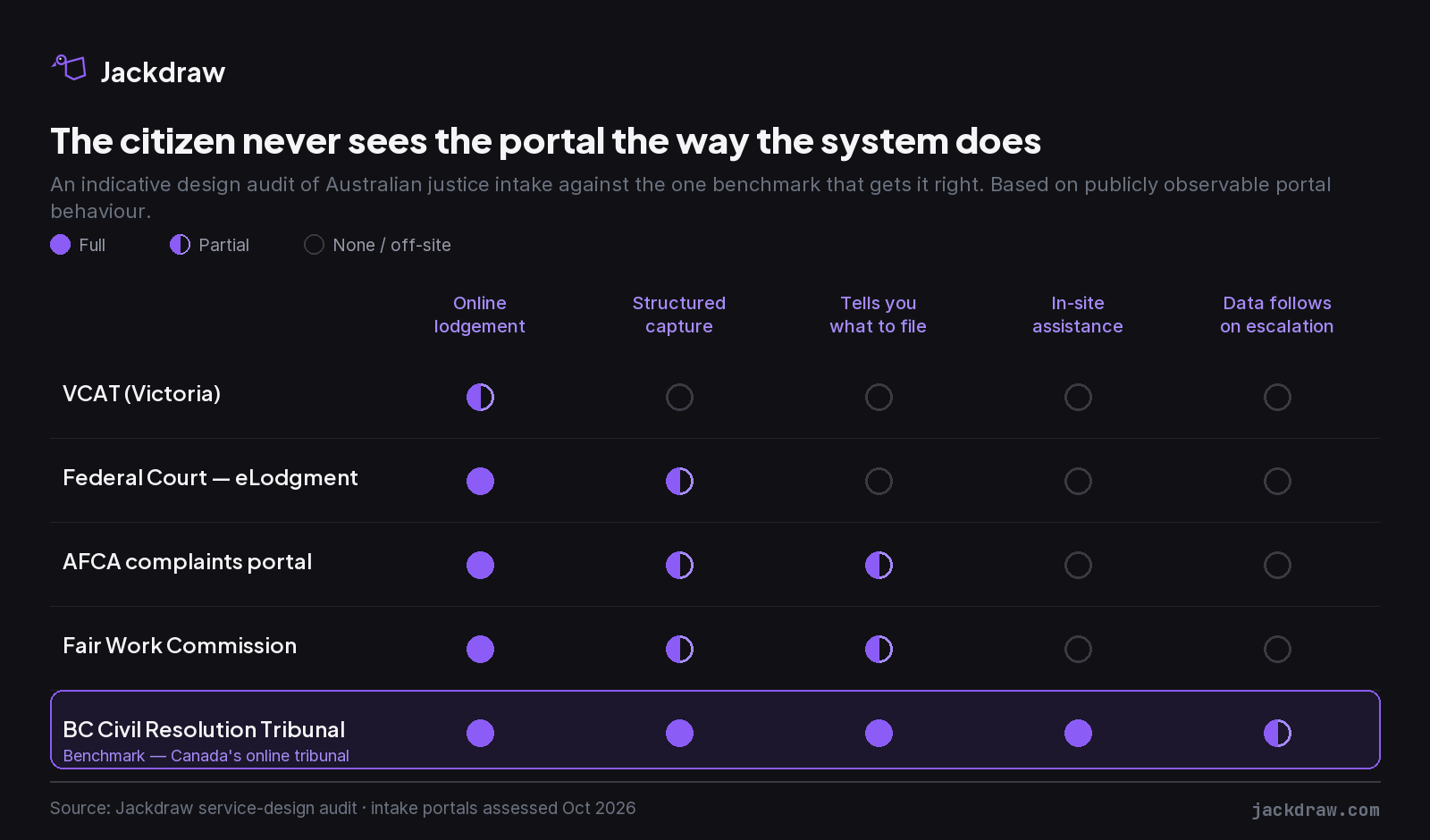
The scorecard above shows how far Australian justice intake sits from the one jurisdiction that has put these pieces together.
This is not speculative — it already works
Every component above is running somewhere in the world. The reform isn't invention; it's synthesis.
Guided intake: British Columbia. Canada's Civil Resolution Tribunal — which handles strata disputes, the close cousin of our owners-corporation matters — begins with a “Solution Explorer” that asks plain-language questions and returns tailored information and self-help tools before a claim is even filed[4]. It's the benchmark in the scorecard above for a reason: it guides, captures and assists where ours only lodge.
Document analysis for self-represented people: Singapore. Singapore's Small Claims Tribunals have deployed a generative-AI tool that summarises each party's case and documents — and translates them across the country's national languages — for magistrates and self-represented users[5]. It's the same document-analysis help, pointed at the people deciding the matter rather than the person bringing it.
Digital intake at scale: the United Kingdom. England and Wales moved money claims online, and the evidence is blunt: online cases complete more than three times faster than the old paper process — around 11 weeks versus 29 — and the service has now passed its millionth claim. Notably, no self-represented litigant is forced online; paper runs in parallel[6].
A single source of truth: Estonia. Estonia's X-Road data exchange enforces a “once-only” principle in law: the state cannot ask a citizen for information it already holds[7]. It's the clearest proof that “build the matter once, reuse it everywhere” is an operating reality, not a fantasy.
Triage at the highest level: Brazil. Brazil's Supreme Court uses an AI system, Victor, to sort thousands of appeals for admissibility and flag those with national significance — and Brazilian courts now run many such tools[8]. Brazil is also a useful caution: reviewers note much of this has been innovation without evaluation[9], a reminder that measuring whether a tool actually helps is part of deploying it.
The guardrails are the whole point
If you propose AI anywhere near government decisions in Australia, you have to reckon with Robodebt. The automated debt-recovery scheme removed human judgement, encoded bad assumptions, and ended in A$1.2 billion repaid and real harm; the Royal Commission's central lesson was the loss of human oversight[10]. The Netherlands learned the same lesson when a court struck down its SyRI welfare-fraud algorithm for opacity and the disproportionate targeting of low-income communities[11].
The design here is the deliberate opposite of both: AI that surfaces and structures, a human that decides. That is also where regulation is landing. The EU's AI Act classifies systems used in the administration of justice as high-risk, precisely because of their impact on the right to a fair trial — and is explicit that AI may support a decision-maker but “should not replace” them; the final decision must stay human[12]. Australia's own Attorney-General's Department opened consultation in 2024 on legislating guardrails for automated government decisions[13]. A reform like this should be built to that standard from day one.
Two more cautions worth designing against. First, convenience can quietly shift outcomes: when Utah moved small claims online, default judgments rose, to the benefit of repeat creditors[14] — a warning that an easier front door must be easier for everyone, not just the well-resourced. Second, guidance must guide, not gate: structured intake needs an “other / explain” path and human-reviewable exceptions, or it becomes its own barrier to justice.
A method I've already put to the test
None of this is a discipline I admire from a distance; it's the way my own work already runs. In customer-experience benchmarking, AI does the heavy lifting — reading, sorting, summarising, checking for gaps — while people own every judgement that matters. The input is structured rather than free-form, the analysis is grounded in sources and reviewable, and nothing is final until a human has checked it. Structured input, grounded analysis, human judgement. It's a deliberately unglamorous model, and that's the point: it's what lets you use AI at scale without it inventing things, and it's the same model that would let a tribunal adopt AI without ever drifting back towards Robodebt.
What that experience has taught me is simpler than any product claim: point AI at the dull, high-volume work and free people to do the judging, and everyone at both ends is better off. In a tribunal, that would mean members with less administrative drag — and applicants who finally get guidance, structure, and a matter that travels with them instead of being rebuilt from scratch. The same enabler, a better experience for everyone in the system.
There's a final dividend worth naming: structured process is measurable process. Today, the time a matter loses is largely invisible. Structure it, and you can see exactly where the delay lives — and, later, show whether a reform actually worked. You can't improve what you can't measure — and that's as true of a tribunal deciding something as personal as a flooded home as it is of anything else. Because the systems we lean on most are the ones that should be designed with the most care.
An idea in progress
If you work in or around the justice system — as a member, an advocate, a designer, or someone who's had to navigate it yourself — I'd like to compare notes, including where you think I've got it wrong.
Start a conversation →References
- Federal Court of Australia, eLodgment and Employment & Industrial Relations National Practice Area (Fair Work jurisdiction, including matters transferred or appealed from the Fair Work Commission). fedcourt.gov.au
- Federal Court of Australia, Preparing documents for lodgment (document category selection at filing). fedcourt.gov.au
- Legal Futures, “Introducing AI ‘should be next phase of tribunal reform’” (Administrative Justice Council on automated case triage). legalfutures.co.uk
- BarTalk, “What is the Solution Explorer?” — British Columbia Civil Resolution Tribunal. bartalk.org
- Supreme Court of Singapore, “New Generative AI-powered Case Summarisation Tool to Help Small Claims Tribunals Users” (2025). judiciary.gov.sg
- HM Courts & Tribunals Service, Reform Digital Services Evaluation — Online Civil Money Claims (2026). insidehmcts.blog.gov.uk
- e-Estonia, Interoperability services (X-Road) and the once-only principle. e-estonia.com
- Oxford Institute of Technology and Justice, AI in Brazilian Courts (Project Victor, Supreme Federal Court). techandjustice.bsg.ox.ac.uk
- Access to Justice Lab, “Brazil's AI-Driven Courts: Innovation Without Evaluation.” a2jlab.org
- IDM, The Robodebt Aftermath: Reflections on the Royal Commission and the Future of AI in Government. idm.net.au
- Library of Congress, “Netherlands: Court Prohibits Government's Use of AI Software to Detect Welfare Fraud” (SyRI, District Court of The Hague, 5 Feb 2020). loc.gov
- EU AI Act, Recital 61 and Annex III — high-risk AI systems in the administration of justice. ai-act-law.eu
- Attorney-General's Department (Australia), Use of automated decision-making by government — consultation paper (2024). consultations.ag.gov.au
- Governing, “Can Online Dispute Resolution Replace Courtrooms?” (Utah ODR and the rise in default judgments). governing.com
- LookUpStrata, “The Victorian Owners Corporations Act Review,” and Warlows Legal on OC v Nguyen (8 July 2025), consolidating owners-corporation fee-recovery matters into VCAT. lookupstrata.com.au
Michelle Sawyer is the founder of Jackdraw, which publishes independent customer experience benchmarks of Australian industries. This is an opinion piece; it describes the justice system in general terms and is not legal advice.