
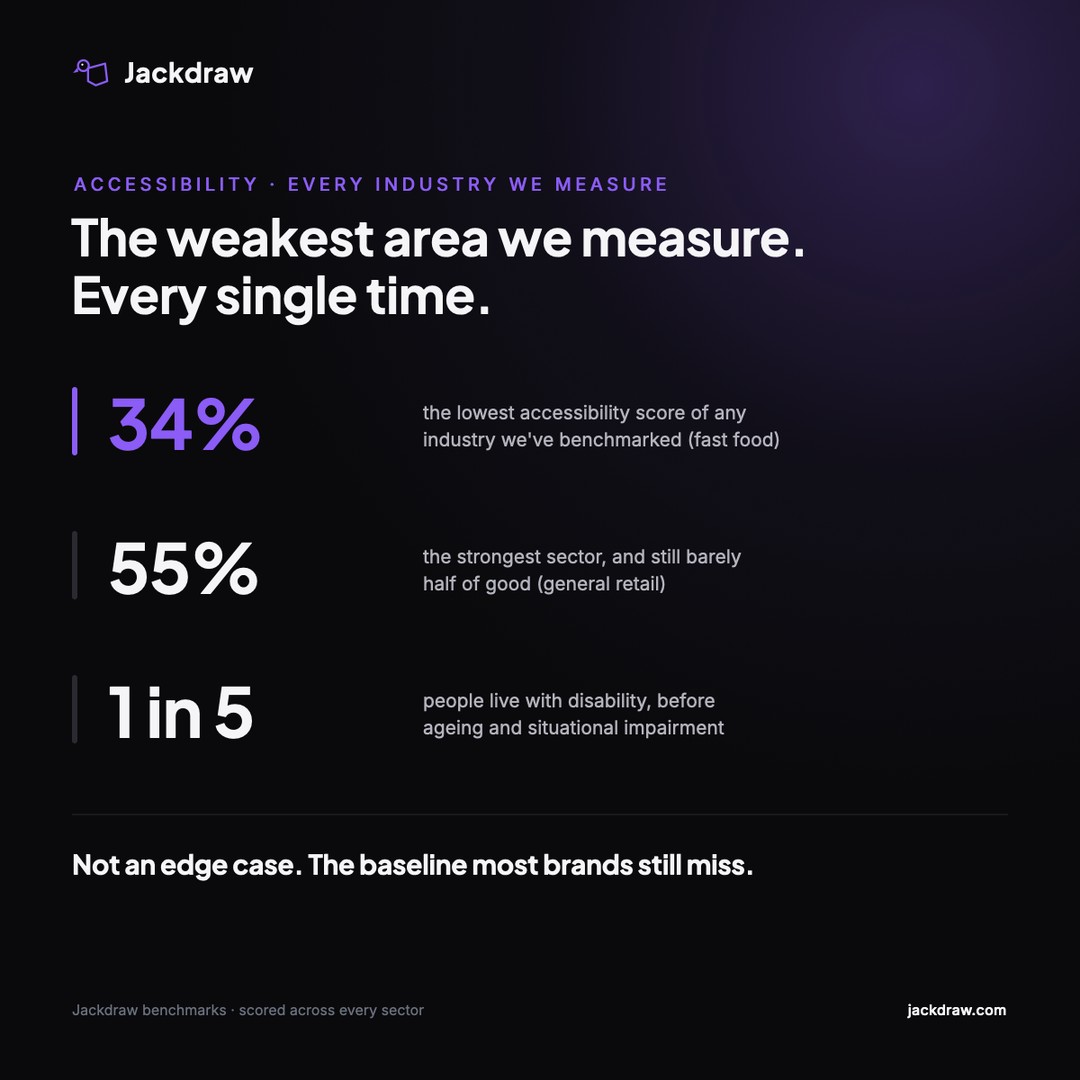
Across every industry we've benchmarked, superannuation, general retail, fashion and fast food, one finding repeats with uncomfortable consistency. Accessibility is the single weakest area, every single time. The scores run from 34 percent in fast food to 55 percent in general retail. Not one sector is getting it right, and no other area of the experience is failing so uniformly.
That is not a run of bad luck. It is the predictable result of how digital accessibility has been governed for the last three decades, or more precisely, how it hasn't.
How it slipped
The technical guidance has existed for a long time. The Web Content Accessibility Guidelines have been around since 1999. The knowledge isn't the problem. The problem is that, for consumer digital experiences, accessibility was a should, not a must.
Think about what that means for a product team. Every roadmap is a fight for finite time. A new feature has a business case and a revenue line. Accessibility has neither of those attached to it in an obvious way. It is largely invisible to the people making prioritisation calls, because most of them don't experience the barriers. It is hard to measure without going and checking. And crucially, missing it carried no consequence.
So it lost. Not because anyone decided accessibility didn't matter, but because a should always loses to a must when time is short. Without a mandatory, enforceable standard, accessibility became everyone's responsibility, which is another way of saying it became no one's. There was no floor, no owner, and no accountability. Predictably, the experience sank to the level the market tolerated, which our data now measures at somewhere between a third and a half of where it should be.
The shift that changes the maths
That governance gap is closing. On 28 June 2025, the European Accessibility Act came into force. It requires consumer digital services, websites, apps, e-commerce, banking, to meet a real standard, WCAG 2.1 Level AA, and it applies to any business selling to EU customers, wherever that business is based. That includes a great many Australian brands that ship offshore.
For the first time in the history of the web, consumer digital accessibility has an enforceable floor. It is no longer a guideline you can defer. It is a legal requirement with a deadline that has already passed, and penalties set by each member state.
And the EU is not an outlier so much as a leading edge. Australia's Disability Discrimination Act already reaches digital accessibility. Litigation in the United States has made inaccessible sites a genuine legal risk. The direction is one way. The should is becoming a must, and the brands sitting at 34 or 55 percent are discovering that the floor moved while they weren't looking.
The reframe that matters
Here is the part I care about most, because compliance is the least interesting reason to do this.
Accessibility is usually framed as a constraint. It is actually one of the most reliable engines of good design we have.
The pattern even has a name: the curb-cut effect. Curb cuts were built for wheelchairs and turned out to help everyone with a pram, a suitcase or a delivery trolley. The same thing happened in digital. Captions were built for deaf users and now everyone watches video on mute on the train. Voice control was built for people who can't use their hands and became a mainstream way to interact. High contrast, larger text, clear focus states, autocomplete, all of it started at the edges and improved the experience in the middle.
That is not a coincidence. Designing for the hardest cases forces clarity. An interface that works for someone using a screen reader has to have a logical structure, meaningful labels and a sensible order, and those are exactly the things that make it faster and less confusing for everyone else. Accessible design is, more often than not, just better design wearing a different name.
There is a market argument too. Around one in five people live with a disability. Add ageing populations, and the situational impairments we all experience, bright sunlight on a screen, a noisy room, a hand holding a child, and the audience for accessible design is not a niche. It is everyone, some of the time.
And the timing is pointed. As voice interfaces and AI assistants become how people interact with services, the underlying structure that makes an experience accessible, clean semantics, clear labels, logical flow, is exactly what those systems need to work well. Accessible design is quietly becoming the foundation of the next interface, not a checkbox on the last one.
What good looks like now
Treating accessibility as a genuine standard, rather than a someday, comes down to a few things. Publish a statement and mean it. Fix the fundamentals first, contrast, alt text, keyboard navigation, focus order, form labels. Build it into the component layer and the flows, because accessible building blocks assembled carelessly still produce an inaccessible experience. Measure it, so it stops being invisible. And give it an owner, so it stops being no one's job.
The bottom line
For thirty years, accessibility was the thing everyone agreed was important and nobody was required to do. The result is written plainly in the data: the weakest part of the digital experience, in every industry, without exception.
That is now changing, because the standard finally has teeth. The brands that treat this as a design opportunity rather than a legal obligation will build clearer, more robust experiences for everyone, and they will get there first. The rest will do the minimum, late, under pressure.
Accessibility was never really the boring compliance job it was made out to be. It was the detail everyone missed. And the details others miss are where the experience actually lives.
Where does your experience actually stand?
Every Jackdraw benchmark scores accessibility as part of experience, across web and app, against 13 established UX frameworks.
Browse the benchmarks →Notes: accessibility scores are from Jackdraw's benchmarks of Australian superannuation, general retail, fashion and fast food. The European Accessibility Act entered into force on 28 June 2025 (WCAG 2.1 Level AA).
Michelle Sawyer is the founder of Jackdraw, which publishes independent customer experience benchmarks of Australian industries.